Reference
IBC Grades Explained
Understanding IBC grading is essential to getting the right container for your application. This guide covers condition grades, usage categories, and the regulatory standards behind them.
Not Sure Which Grade You Need?
Tell us about your application and we'll recommend the right grade and configuration.
Condition
Condition Grades: A, B & C
Grade A — Like-New Condition
30-40% less than newAppearance
Minimal cosmetic wear. Clean white or translucent bottle with no staining, yellowing, or odor. Cage is straight with intact zinc coating. Labels may show minor residue.
Bottle Condition
No cracks, scratches deeper than surface level, or UV degradation. Wall thickness within 95% of original specification.
Valve & Hardware
Original valve in excellent condition or replaced with new butterfly valve. Smooth operation, no leaks.
Best For
Food and beverage, pharmaceutical, cosmetics, potable water storage, any application where cleanliness and appearance matter.
Grade B — Good Condition
40-55% less than newAppearance
Light to moderate cosmetic wear. Bottle may show slight discoloration or label ghosting. Cage may have minor surface rust or bent wires (not structural).
Bottle Condition
Structurally sound with no cracks or punctures. May have light surface scratches. Passes pressure test at 3 PSI.
Valve & Hardware
Functional valve that operates smoothly. May show cosmetic wear. Seal integrity confirmed by pressure test.
Best For
Agricultural chemicals, soaps, detergents, industrial solvents, non-food manufacturing, construction site water.
Grade C — Fair Condition
55-70% less than newAppearance
Visible wear including discoloration, moderate label residue, and cosmetic cage damage. Bottle may be yellowed from UV exposure.
Bottle Condition
Structurally intact and leak-tested. May have visible scratches and wear marks. Wall thickness meets minimum safety threshold.
Valve & Hardware
Functional. May require replacement for critical applications. Basic flow control confirmed.
Best For
Rainwater collection, irrigation, non-critical bulk storage, waste collection, construction water, decorative garden use.
Inspection
Detailed Inspection Criteria by Grade
Our grading inspectors follow these specific checklists for each grade. Every criterion must be met for the container to receive that grade designation. A single failure on any line item bumps the IBC to the next lower grade.
Grade A — Inspection Checklist (17 Points)
Grade B — Inspection Checklist (15 Points)
Grade C — Inspection Checklist (14 Points)
By Industry
Industry-Specific Grade Recommendations
Different industries have different requirements. These recommendations reflect regulatory mandates, industry best practices, and practical considerations for each sector.
Food & Beverage Processing
Grade A (food-grade certified) or Reconditioned Grade A
FDA 21 CFR 177 requires food-contact containers to be free from contamination. Grade A IBCs with documented food-grade history or professionally reconditioned food-grade IBCs are the only options. Previous contents must be food-grade throughout the container's history, or professional reconditioning with cleaning validation documentation is required.
Pharmaceutical Manufacturing
New IBC or Grade A (food-grade certified)
Pharmaceutical applications often require virgin-plastic containers for active pharmaceutical ingredients (APIs). Grade A food-grade IBCs may be acceptable for non-API uses such as cleaning solution storage, water-for-injection holding, or excipient transport. Verify with your quality assurance team.
Chemical Manufacturing & Distribution
Grade A or Grade B with UN/DOT rating
Hazardous chemical storage and transport requires containers with valid UN 31HA1 performance certification. Grade A or B IBCs with current UN ratings are suitable. Verify chemical compatibility with HDPE before use. Non-hazardous chemicals can use any grade based on budget preferences.
Agriculture & Farming
Grade B or Grade C
Agricultural applications such as fertilizer storage, pesticide mixing, irrigation water, and livestock supplements rarely require food-grade or pristine containers. Grade B offers the best balance of condition and value; Grade C provides maximum savings for single-season or non-critical uses.
Cannabis & Hemp Cultivation
Grade A for extraction solvents, Grade B for nutrient mixing
Extraction-grade solvents and finished product storage should use Grade A containers with documented clean history. Nutrient solution mixing and irrigation water storage can use Grade B. Waste water collection can use Grade C.
Cosmetics & Personal Care
Grade A (food-grade) or New
Cosmetics and personal care product manufacturing typically requires containers that meet FDA standards for materials that contact products applied to the human body. Grade A food-grade IBCs satisfy this requirement. New IBCs are recommended for luxury or premium product lines.
Construction
Grade C
Construction site water supply, dust suppression, concrete curing, and equipment washing are ideal applications for Grade C IBCs. Cosmetic appearance is irrelevant, and the significant cost savings make Grade C the clear choice for temporary project-based deployments.
Water Treatment & Municipal
Grade A or B with UN/DOT rating for treatment chemicals; Grade C for non-chemical water
Water treatment chemicals (chlorine solutions, pH adjusters, flocculants) often require UN/DOT-rated containers. Non-chemical applications such as backwash water holding or irrigation water supply can use any grade based on budget.
Wine & Spirits
Grade A (food-grade certified)
Wine, spirits, and craft beverage applications require food-grade containers. Grade A IBCs with documented food-grade history are standard for bulk wine transfers, juice concentrate storage, and cleaning solution holding. Reconditioned food-grade IBCs are also acceptable.
Soap & Detergent Manufacturing
Grade B (330 gallon, 3" valve)
Soap and detergent manufacturers typically use 330-gallon IBCs with 3-inch valves for viscous product handling. Grade B containers offer sufficient cleanliness for surfactant-based products while providing significant cost savings. Food-grade certification is not required for non-ingestible products.
Categories
Food Grade vs Chemical Grade
Food Grade
IBCs that meet FDA 21 CFR 177 standards for food-contact surfaces. The HDPE bottle must be free from contamination by non-food substances throughout its history, or professionally reconditioned to FDA standards with documented cleaning validation. Food-grade IBCs are required for storing or transporting edible oils, syrups, juices, wine, sauces, and any product intended for human consumption.
Non-Food Grade (Industrial)
Standard IBCs suitable for industrial liquids that do not contact food products. These containers may have previously held soaps, detergents, lubricants, agricultural chemicals, or other non-food industrial products. They are structurally identical to food-grade IBCs but lack the contamination-free history required for food contact.
Chemical Grade (Hazmat)
IBCs rated for storing and transporting hazardous materials. These containers carry UN/DOT performance ratings (typically UN 31HA1/Y or UN 31HA1/X) indicating they have passed drop tests, stacking tests, hydraulic pressure tests, and vibration tests per UN packaging standards. Required for DOT-regulated transport of hazardous chemicals.
Grade Changes
Grade Upgrading & Downgrading
Grades are not permanent. IBCs can be upgraded through reconditioning or downgraded when inspection reveals issues not visible at initial assessment. Here's how the process works.
Grade B upgraded to Grade A equivalent
Full reconditioning (triple wash, new valve, new gaskets, pressure test, QC sticker). Requires that the bottle passes Grade A visual inspection criteria after cleaning.
Grade C upgraded to Grade B equivalent
Cleaning, valve replacement, gasket replacement, cage straightening, and pressure test. Bottle must meet Grade B structural criteria after cleaning.
Grade A downgraded to Grade B
Downgrading occurs when a Grade A IBC is found to have hidden defects during secondary inspection, such as faint odor retention, minor internal staining visible only under LED, or label ghosting that cannot be removed.
Grade B downgraded to Grade C
Occurs when inspection reveals more wear than initially assessed: deeper scratches, more extensive cage rust, or minor valve issues that affect cosmetic grading but not structural integrity.
Re-grading after reconditioning
After completing the full 8-step reconditioning process, each IBC is re-graded based on the final condition of the bottle and cage. Reconditioning typically raises a Grade B to Grade A and a Grade C to Grade B, but this depends on the base condition of the bottle (reconditioning cannot reverse UV damage or deep scratches).
Global Standards
International Grading Standards Comparison
IBC grading systems vary by country and region. If you're importing or exporting IBCs, understanding these differences is essential for proper documentation and compliance.
| Standard | Grades | Basis | Notes |
|---|---|---|---|
| IBC San Francisco (US) | Grade A, B, C | Visual inspection + pressure test + wall thickness measurement | Three-tier system based on cosmetic and structural condition. Grade A = like-new, Grade B = good, Grade C = fair. Used across US IBC suppliers with minor variations. |
| European (ECMA / Schütz TICKET system) | Category 1, 2, 3, 4 | Previous contents + bottle condition + remaining lifespan | European grading places more emphasis on previous contents history than cosmetic condition. Category 1 = food-grade clean, Category 4 = hazmat residual. Schütz uses a proprietary TICKET system for reconditioning traceability. |
| UN/DOT Performance Rating | X, Y, Z (Packing Groups I, II, III) | Drop test, stacking test, hydraulic pressure test, vibration test | Not a condition grade but a performance certification. X = most hazardous (Packing Group I), Y = moderately hazardous (Packing Group II and III), Z = low hazard (Packing Group III only). Separate from cosmetic grading. |
| Australian Standard (AS 4708 / APCO) | Serviceable, Reconditioned, Reject | Structural integrity + leak test + compliance | Simpler three-tier system. Serviceable = can be reused as-is. Reconditioned = has been professionally cleaned and repaired. Reject = not suitable for reuse. APCO (Australian Packaging Covenant) adds recycling and sustainability requirements. |
| ISO 16103 (International) | New, Reusable, Reconditioned, Remanufactured | Container lifecycle stage + compliance with UN performance standards | ISO 16103 defines terms and testing requirements for packaging used in transport of dangerous goods. More focused on hazmat compliance than cosmetic condition. |
Compliance
Regulatory Standards
FDA 21 CFR 177
Governs the types of polymers and additives permitted in food-contact containers. HDPE used in food-grade IBCs must comply with Section 177.1520 (Olefin Polymers). Reconditioned food-grade IBCs must demonstrate that cleaning procedures remove all contaminants to FDA-acceptable levels.
UN/DOT Performance Ratings
IBC containers intended for hazardous material transport must pass UN performance tests including a 1.8-meter drop test, stacking test (superimposed load for 28 days), internal pressure test, and vibration test. The UN 31HA1 designation indicates a rigid composite IBC with an HDPE inner receptacle. The Y rating indicates Packing Group II and III suitability; X indicates all three Packing Groups.
OSHA Requirements
OSHA requires proper labeling of IBC contents per the Globally Harmonized System (GHS). Containers must display product identifiers, hazard pictograms, signal words, and precautionary statements. Employers must ensure IBC storage areas meet ventilation, containment, and access requirements per 29 CFR 1910.106.
DOT 49 CFR
The Department of Transportation regulates IBC transport of hazardous materials under 49 CFR Parts 171-180. IBCs must maintain valid UN certification, proper markings, and documentation (shipping papers, emergency response info). Reconditioned IBCs used for hazmat must be re-certified by an authorized facility.
Decision Guide
How to Choose the Right Grade
- Identify your contents: Food and pharma products require food-grade certified IBCs. Hazmat requires UN/DOT rated containers.
- Consider end-use visibility: Grade A is ideal when the container is customer-facing. Grade C works perfectly for back-of-house operations.
- Budget vs longevity: Grade A costs more but lasts longer in multi-cycle use. Grade C delivers the best single-use value.
- Check regulations: Some industries mandate specific grades. When in doubt, consult your compliance team or ask us.
- Consider reconditioning: If you need Grade A quality but only Grade B or C is available, reconditioning can upgrade the container to meet your requirements.
- Match grade to lifecycle: For single-use or short-term projects, Grade C maximizes savings. For repeated multi-year use, Grade A or reconditioned provides the lowest total cost of ownership.
Quick Decision Matrix
Real-World Grading
Every Label Tells a Story
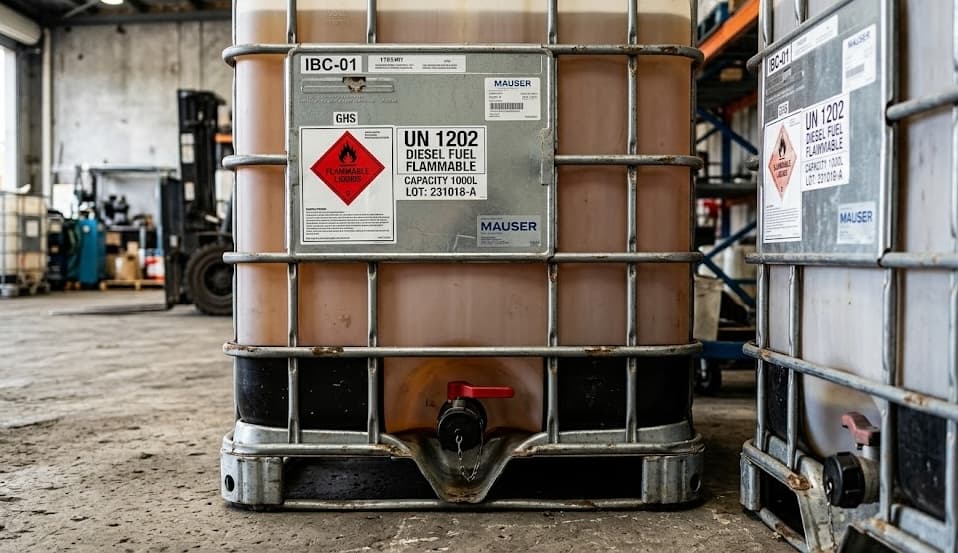
UN markings, GHS hazard diamonds, manufacturer codes — the labels on an IBC tote contain critical data about its history, capacity, and approved contents. Our grading team reads every label to ensure accurate classification.
This Mauser IBC carries a UN 1202 classification for diesel fuel — a common chemical-grade container that, after proper cleaning, can be reconditioned for many non-food applications.
Find Your Perfect Grade
We carry all grades in stock. Tell us your application and we'll recommend the most cost-effective option that meets your requirements.