Cleaning & Reconditioning
Like New. Guaranteed.
Our ten-step reconditioning process restores used IBC totes to meet FDA, UN/DOT, and food-grade standards — extending each container's service life by years while saving up to 92% of the carbon cost of buying new.
Request Cleaning Service
Need IBCs cleaned or reconditioned? Tell us the quantity and previous contents, and we'll quote turnaround time and pricing.
The Process
10-Step Cleaning & Reconditioning Protocol
Every IBC that passes through our facility follows a rigorous, documented cleaning protocol. Here is the complete process in detail — from intake to final reassembly.
Intake & Previous Contents Logging
Every IBC entering our cleaning line is assigned a unique work-order number. We document the previous contents (from customer disclosure and label inspection), the manufacturing date molded into the HDPE bottle, and any visible damage or contamination. This record follows the container through every step and becomes part of the final inspection certificate.
External Inspection
A technician visually inspects the complete exterior: steel cage tube straightness, weld integrity, galvanized coating condition, pallet runner soundness, and label/placard condition. Any structural defect that would prevent safe reuse is flagged. The cage and pallet condition determine whether the container enters the cleaning track or is diverted to recycling.
Residual Product Drainage
The IBC is inverted or tilted on a drainage rack to remove all residual product. Liquid residues are collected in segregated drums based on chemical compatibility. Non-hazardous liquids go to our on-site wastewater treatment system. Hazardous residues are containerized and transferred to a licensed disposal facility. Every drop is accounted for — nothing goes down the drain untreated.
High-Pressure Pre-Rinse
The bottle interior is blasted with high-pressure hot water at 2,500-3,000 PSI and 160°F. Rotating spray heads mounted on a lance are inserted through the top opening to reach every interior surface. This stage removes the bulk of any adhered residue, softens dried films, and flushes out particulate matter. The rinse water is captured and routed to our water treatment system.
Alkaline Detergent Wash
The second wash stage uses a food-safe alkaline detergent solution heated to 160-180°F. The detergent is formulated to break down organic compounds, oils, fats, proteins, and chemical films without degrading the HDPE. The solution is recirculated through the bottle for a set dwell time calibrated to the type of residue being removed — typically 5-15 minutes depending on contamination level.
Acid Rinse (When Required)
For containers that held mineral-heavy or scale-forming products, an acid rinse stage is added. A dilute citric or phosphoric acid solution dissolves mineral deposits, removes hard water scale, and neutralizes any alkaline detergent residue. This step is standard for IBCs being reconditioned for pharmaceutical or high-purity food applications.
Potable Water Final Rinse
The bottle receives a thorough final rinse with clean, potable-quality water to remove all traces of cleaning agents. The rinse water exits crystal-clear — if any turbidity, color, or odor is detected, the bottle is sent back for an additional wash cycle. The final rinse water is tested and its quality is recorded in the work order.
Sanitization (Food-Grade / Pharma)
For containers destined for food-contact, beverage, pharmaceutical, or cosmetic applications, a dedicated sanitization step is applied after the final rinse. The bottle interior is treated with an FDA-approved sanitizer — typically peracetic acid or a quaternary ammonium compound — at the proper concentration and contact time. The sanitizer is drained and the bottle is not re-rinsed, as these agents are designed to be no-rinse at use concentration.
Forced-Air Drying
The cleaned bottle is dried using filtered, heated air blown through the interior. This prevents water spots, eliminates standing moisture that could harbor microbial growth, and prepares the container for immediate reassembly. Drying time is typically 15-30 minutes depending on ambient conditions. For pharma-grade applications, HEPA-filtered air is used to prevent particulate recontamination.
Parts Replacement & Reassembly
All wearable components are replaced with new OEM-specification parts: 2-inch butterfly valve with polypropylene body, dust cap, lid gasket (EPDM or silicone depending on application), breather vent, and fill cap. Damaged cage sections are repaired with matching galvanized tubing. Cracked or broken pallets are swapped for sound replacements. The container is fully reassembled and ready for the next stage.
Chemistry
Cleaning Agents & Their Properties
We use a range of cleaning agents matched to the specific residue being removed. Every chemical in our process is selected for effectiveness, HDPE compatibility, and environmental safety.
Alkaline Detergent (Sodium Hydroxide-Based)
Effective against organic soils including fats, oils, proteins, and most food residues. Safe for HDPE at recommended concentrations (1-3% by weight). Rinses cleanly with minimal residue. Operating temperature: 140-180°F.
Common applications: Food-grade IBCs, beverage containers, soap and detergent residues, agricultural chemical containers
Citric Acid Solution
Mild organic acid that dissolves mineral scale, hard water deposits, and metal oxide films. Non-toxic and biodegradable. Also serves as a neutralizing rinse after alkaline wash stages. Operating temperature: ambient to 140°F.
Common applications: Pharmaceutical containers, high-purity food applications, post-alkaline neutralization
Peracetic Acid Sanitizer
Broad-spectrum antimicrobial effective against bacteria, yeasts, molds, and viruses. FDA-approved for food-contact surface sanitization. No-rinse at use concentration (80-200 ppm). Decomposes to acetic acid, water, and oxygen — leaves no harmful residue.
Common applications: FDA-grade sanitization for food, beverage, and pharmaceutical IBCs
Quaternary Ammonium Compounds (Quats)
Cationic surfactant-based sanitizers effective against a broad range of pathogens. Low toxicity, odorless, and non-corrosive. Effective at low concentrations (150-400 ppm). Provides residual antimicrobial activity on surfaces.
Common applications: Food-contact sanitization, cosmetic containers, general-purpose antimicrobial treatment
Solvent-Based Cleaners
Specialized solvents for removing petrochemical residues, adhesives, inks, and cured resins that water-based cleaners cannot dissolve. Includes d-limonene (citrus-derived), mineral spirits, and acetone. Used in closed-loop systems with vapor recovery.
Common applications: Chemical industry IBCs, ink and dye containers, adhesive containers, petrochemical residues
Water Treatment
Process Water Management
Our cleaning operation consumes approximately 30-40 gallons of water per IBC — a fraction of the 1,850 gallons needed to manufacture a new container. But we go further: all process water is treated and recycled to minimize consumption and prevent environmental contamination.
- Gravity settling — process water first passes through settling tanks where suspended solids drop out. Settled sludge is periodically removed and disposed of properly.
- Chemical neutralization — pH is adjusted to the 6.5-8.5 range required for discharge. Alkaline and acid rinse waters naturally neutralize each other when combined.
- Filtration — water passes through multi-stage filters (25-micron, 10-micron, 5-micron) to remove fine particulates before discharge or recirculation.
- Recycling — up to 60% of our process water is recirculated for use in pre-rinse stages, reducing total fresh water consumption.
Testing
Residue Testing Methods
After cleaning, we verify that the IBC interior is free from contamination using multiple testing methods. The testing protocol varies based on the intended reuse application.
- Visual inspection — trained technicians inspect the bottle interior under high-intensity LED lighting. Any visible residue, staining, or film triggers a re-wash.
- Rinse water analysis — the final rinse water is tested for pH, total dissolved solids (TDS), conductivity, and turbidity. Values must fall within spec before the IBC passes.
- Odor test — a clean IBC should be odorless. Any detectable odor indicates residual contamination and the container is returned for additional cleaning.
- ATP swab testing — for food and pharma applications, adenosine triphosphate (ATP) swabs verify that biological contamination has been eliminated. Results are recorded in the work order.
- Third-party lab testing — available upon request for customers requiring independent verification. We partner with accredited analytical labs for GC/MS, ICP, and microbiology testing.
Standards
Certifications & FDA Validation
- FDA 21 CFR — our cleaning process meets FDA requirements for containers used with food, beverages, and pharmaceutical products. Cleaning validation protocols are documented and available for customer audit.
- UN/DOT Certification — reconditioned IBCs are re-certified for the transport of hazardous materials per 49 CFR 178.801 retest standards. Each unit receives a new UN marking after successful testing.
- IICRC Standards — cleaning technicians follow Institute of Inspection, Cleaning and Restoration Certification protocols adapted for industrial container cleaning.
- SQF Compliant — our facility and processes align with Safe Quality Food program requirements for container hygiene.
- Pressure testing — each reconditioned IBC is filled and pressure-tested at 1.5x rated working pressure (approximately 10.5 PSI for standard composite IBCs). The container is held at test pressure for a minimum of 5 minutes while inspected for leaks. Units that fail are immediately routed to recycling.
Documentation
Cleaning Certificate Details
Every reconditioned unit receives a dated inspection certificate. This document provides full traceability and is essential for food-grade, pharmaceutical, and hazmat applications.
Each certificate includes:
- Unique work-order number and container serial number
- Previous contents (as disclosed by seller or identified by inspection)
- Cleaning method and agents used with concentrations and temperatures
- Sanitizer type, concentration, and contact time (if applicable)
- Replacement parts list with part numbers
- Pressure test results (test pressure, duration, pass/fail)
- Rinse water quality results (pH, TDS, turbidity)
- Technician ID and QC inspector sign-off with date
Industry Protocols
Cleaning for Specific Industries
Different industries have different cleanliness requirements. We tailor our cleaning protocol to match the regulatory and quality standards specific to your sector.
Food & Beverage
Full 10-step process with alkaline wash, acid rinse, and peracetic acid sanitization. FDA 21 CFR compliant. All replacement parts are FDA food-contact grade. Certificate of cleaning documents previous contents, cleaning agents used, sanitizer concentration, and contact time. Suitable for juice, syrup, oil, sauce, flavoring, and potable water applications.
Pharmaceutical & Cosmetic
Enhanced protocol with HEPA-filtered drying air, pharma-grade sanitizers, and additional rinse-water quality testing. Cleaning validation documentation available for customer audit. All replacement parts are traceable to material certificates. Suitable for API intermediates, excipients, fragrance oils, and personal care ingredients.
Chemical & Industrial
Cleaning protocol is customized based on the specific chemical previously held. We consult SDS documentation to select compatible cleaning agents and ensure complete residue removal. For containers transitioning between incompatible chemicals, we perform compatibility testing on rinse water. Suitable for solvents, acids, bases, surfactants, and lubricants.
Agricultural
Standard triple-wash with emphasis on removing fertilizer salts, pesticide residues, and organic matter. IBCs used for liquid fertilizers, herbicides, and fungicides are cleaned and returned to agricultural service. We follow EPA triple-rinse guidelines for pesticide containers where applicable.
Turnaround
Cleaning Turnaround by Volume
Turnaround starts from the day containers arrive at our facility. Heavily contaminated IBCs or those requiring specialized protocols may take additional time.
Rush Service
Rush Cleaning Service
Need IBCs cleaned urgently? Our rush service bumps your containers to the front of the queue for fastest possible turnaround.
- 24-hour rush — for 1-5 IBCs with standard cleaning requirements. Containers in by morning, ready by the next morning. Premium rate applies.
- 48-hour rush — for 6-15 IBCs. Available for most contamination types. Second-shift processing may be utilized.
- Priority queue — for larger volumes. Not same-day, but moves your order ahead of standard queue by 50%. Modest surcharge.
Rush service includes all standard cleaning steps — we never cut corners to speed up the process. The time savings come from priority scheduling and dedicated crew assignment.
Quality
Quality Control & Rejection Rate
Every IBC that passes through our reconditioning line is individually tracked. Technicians log each stage of the process, and a separate QC inspector performs the final sign-off before the unit is cleared for sale or return.
Our rejection rate for reconditioned IBCs averages around 8%. These are containers that arrive for cleaning but fail structural or integrity tests — cracked bottles, warped sidewalls, or damaged cages that compromise stacking safety.
Rejected units are routed directly to our recycling line. No substandard container ever reaches a customer. We also provide before-and-after photographic documentation for customers who request it — showing the container at intake and after reconditioning.
Buy reconditioned IBCs →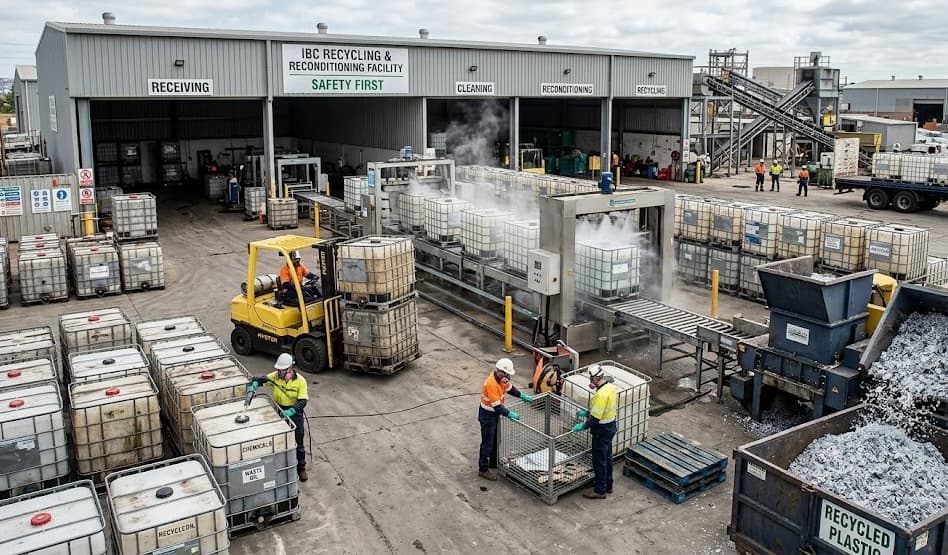
See It In Action
Industrial-Scale Cleaning Operations
Our dedicated reconditioning facility features high-pressure wash bays, steam cleaning systems, and a team of trained technicians processing hundreds of IBCs every week.
Extend the Life of Every Container
Professional cleaning and reconditioning is the most cost-effective and sustainable way to keep IBCs in service. Let us bring your containers back to spec.